Tuesday, October 13, 2009

Butternut Squash Bread


Fall has arrived! The weather is turning cooler and our minds have turned to meals inspired by this great new season. Jim has requested several cold weather delights recently, one of which was winter squash.

We’ve been frequenting the farmers market throughout the summer, and have eagerly awaited each Saturday morning visit. Unfortunately, October is the last month that our market is open, so we’re trying to ‘pack it in’ as much as possible in these sad few remaining weeks. Two weeks ago, we purchased a large butternut squash and an acorn squash as part of our massive farmers market haul. The acorn squash was consumed that weekend, but the butternut stuck around for a while—that’s the great thing about winter squashes: they have a long shelf life and don’t need to be used immediately.

I used the larger part of the butternut squash as a side to dinner last Saturday night, but I was left with the lower, bulbous portion. I pondered all week on the issue of where I could employ this leftover squash; I had a full week of dinners already planned, none of which would accommodate a squash side dish. Finally, last night I decided on the perfect application: a butternut squash quick bread (in the style of a zucchini or pumpkin bread.) My starting point was a recipe for zucchini bread from this book, with many alternations (some accidental, some intentional) made in order to come to this final product.


I threw this together in my last few minutes before Jim arrived home from work, so he was welcomed home to the smell of cinnamon and the promise of a tasty breakfast treat for tomorrow (treats like these are dessert to me and breakfast to him). Verdict: delicious, sweet—but not too sweet. It’s especially great with a smear of cream cheese.

As an extra note: if you have more grated squash than will be used in the bread, try topping a green salad with it—we did that last night after I made the bread and it was delightful!

Butternut Squash Bread

Ingredients:
DRY:
1 2/3 c whole-wheat pastry flour
1/3 c oat bran
1 ½ t baking powder
1 t baking soda
¼ t salt
2 t ground cinnamon
1 t ginger

WET:
¾ c buttermilk
½ c packed brown sugar
1 egg
1 egg white
2 T vanilla extract
1 t coconut extract
1 generous packed cup of grated butternut squash (probably close to 1 ¼ c)
handful of dark raisins (maybe ¼ c)

Method:
Mix dry ingredients in large bowl with fork (the wet ingredients will be added to this bowl later, so pick a bowl big enough to accommodate the finished batter). Mix the wet ingredients, through the extracts, in a smaller bowl, whisking to beat eggs and to ensure that everything is well combined. Add buttermilk mixture to dry ingredients, stir a few times to moisten. Add squash and raisins, and fold in until everything is combined. Spray a 8 x 4 loaf pan with cooking spray, pour in the batter and bake at 350 until a wooden skewer (or toothpick) comes out clean (I think it took mine about 50 minutes, but I admit that I wasn’t paying much attention to the time—it’s done when it’s done).

Let cool in pan for 15 minutes, then release onto a wire cooling rack to cool completely before cutting.

Happy Autumn!!

Saturday, February 9, 2008

Chicken and Wild Rice Soup

I’ve been absent for quite a while, and the story and recipe that I am about to relate is old. I’ve been busy—painfully busy—for these past few months and, while I had a chance to scribble down my recipe soon after creating this soup, I have only now found the time to relate it here. Yes, the past few months have been a whirlwind of seemingly constant work—at various jobs—sprinkled with exercise, dinners at home, sleep…and very little else. But I’ve finally found a moment to tell the story of a woman on the edge of mental collapse, a man with a sudden flu and the pot of soup that helped us both recover.

I had a very rough time last fall—fighting a gargantuan workload and an ever-deepening depression that I seemingly could not conquer. I seem to have rebounded to an extent, although I occasionally swing back into hopelessness and despair—just now the trips are shorter in duration and perhaps lack the depth of my previous journeys. I’ve mostly been working from home since last July (except for my now once-weekly stint at the bakery), so I was here the day that Jim woke up to discover that he had somehow caught a nasty flu-like sickness. He rides the metro everyday with throngs of sick people and works in somewhat close quarters with people he often describes as “freaks”, so his acquiring a flu came as no great surprise. He was sniffly, feverish and physically beat. Despite my own misery at the time, I could not help but to feel overwhelmingly that I wanted to erase his pain, to make him better.

I find my reaction to his suffering sort of curious. He was in pain and miserable, and even though I was wallowing in my own special type of misery at the time, the desire—or need, even—to erase his pain and make him feel better took me over. It became my quest…until I realized that there’s really not much I could do for him, aside from offering pity. There’s a terrible helplessness involved when you want so badly to fix what you could never really have a hope of changing. Borne of this helplessness was my offer to make him soup…if he wanted it (when he gets sick he’s usually not much of an eater—even when he really needs some sustenance). It was really the only thing I had to offer, other than the aforementioned pity and spoken expressions of care and love. Faced with the array of soup choices that I put before him, he selected a chicken soup with wild rice.

So, in the mid-afternoon, I took a break from work to ascend to the kitchen and begin my feeble attempt at curing his sickness. This offered me a nice two-hour respite from my work, and the opportunity to fiddle about in the kitchen…but it also ensured that I’d be working while I ate dinner and far beyond. After we both finished dinner, I continued to work on my computer in the basement and he lay feet away from me on the couch, still feeling like crap. Finally, when I had enough of work for the day and could hardly see straight, I announced that I was off to bed. I walked over and gave him a kiss goodnight on the cheek (so as not to catch his foul sickness). He turned and looked up at me and said, “You always take such good care of me when I’m sick. Thank you.”. For what seemed like the first time in weeks, I cracked a smile. It was a much-needed reminder that there are some things special enough to make life worthwhile, even when it seems so tough. He’s one of them, for sure.

Chicken and Wild Rice Soup

Ingredients:
3 Boneless skinless chicken breasts
1 whole onion, peeled
10 whole cloves
1 onion, diced
3 carrots, diced
3 stalks celery, diced (reserve the tops and leaves of the celery, to flavor the stock)
1 leek, well rinsed and cut into small pieces (whites and middle whites only—no greens)
8 cloves of garlic, minced
10 cremini mushrooms, sliced
15-20 sprigs of fresh thyme
4-5 branches rosemary
2 bay leaves
dried thyme (2 t ?)—adjust to your taste*
dried rosemary (1 t ?)—adjust to your taste*
dried rubbed sage (1 t ?)—again, adjust to your taste*
Fresh Italian parsley, chopped (about ¼ c)
1 14 oz can of fire roasted diced tomatoes, drained
1 cup of white wine**
½ cup of wild rice, rinsed
2-3 boxes of low sodium chicken broth

*Read: this is an estimate; I failed to write down the amount.
**I prefer to cook with Sauvignon Blanc. I avoid Chardonnay because its oaky quality will become too concentrated in the final product. I avoid Pinot Grigio because I really can’t stand to drink it…so that bottle is going to be around for a long, long time. Sauvignon Blanc I find to be non-objectionable as a drinking wine, and it doesn’t seem to have an off impact on the flavor of the final dish.

Method:
Stud the whole peeled onion with cloves. (Both the onion and the cloves add great depth to a poultry based broth, as they simmer with the other ingredients. The same might be true for vegetable stocks or other meat based stocks, but I have not experimented with that yet.)

One onion, studded

Make a bouquet garni: with kitchen twine, tie together the celery tops, whole thyme sprigs, and rosemary branches. (You can see in the picture that this time I didn’t tie the celery tops in, and instead just added them separately—in subsequent soups, they’ve gone in my bouquet garni instead, and it’s worked well…so my photos and instructions here are not in complete agreement). This quick operation will make your life so much easier when the soup is done—the herbs release a wonderful flavor and you only have to fish out one large, obvious bundle of herbs instead of hunting down individual branches.

My bouquet garni
Brown the chicken breasts in a soup pot that’s been lightly coated in olive oil (spray if you can)—not until they’re cooked through, but at least until they’re browned on each side (this will provide some additional flavor, both to the chicken itself and to the ingredients that are subsequently cooked in the pot). When browned, remove the chicken breasts to a plate and set aside. Add onions, leeks, carrots and celery to the pot. As they start to exude their juices, scrape up any browned bits from the bottom of the pot (the “fond”, source of oh-so-much-flavor). When the veggies have softened (not browned), add the garlic and cook, stirring, until fragrant—about 1 minute. Add the dried herbs (thyme, rosemary and sage), stirring to combine. Add the white wine and allow the moisture to cook off. Add the tomatoes and chicken broth (I gave a range above—start with an amount and keep adding to achieve what ever consistency you would describe as “soup”—my soups tend to be a tad “stew-like”). Add the studded onion, bouquet garni (and the celery tops if you didn’t include them in the bouquet garni), bay leaves, salt and pepper. Nestle the chicken breasts into the mixture (and pour in any accumulated juices on the plate), bring the broth to a slow boil and cover, lowering heat to maintain the slow boil. Cook until the chicken is done
When the chicken is cooked through, remove the breasts from the soup to a clean plate. When cool enough to handle, shred the chicken into small pieces and return it to the soup. Add the wide rice, return the soup to a boil, cover, lower heat and cook until the rice is done, about 45-55 minutes. Add additional broth as necessary during the cooking to maintain the desired consistency. Before serving, remove the studded onion, bay leaves and bouquet garni (and celery tops if added separately). Serve, enjoy, heal.
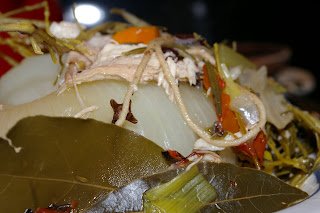
Bouquet garni and onion, spent and removed from the soup.

Wednesday, October 3, 2007

The Good Little (Half) Greek Girl Cooks Dinner


There’s something about cooking Greek food that just feels right to me. It could be that it’s generally a healthful cuisine, filled with lean proteins and fresh vegetables. It could be that I’ve been eating and cooking this type of food for so long that I know the flavoring and ingredient options well, and it’s an easy go-to for a nice meal (Mediterranean cuisine is probably my cooking “comfort zone”, but Jim tells me that I have a “knack” for Asian). It could be the pleasure of the flavors and aromas of the food and the warm feelings that they inspire in me-- we didn’t have a ton of Greek cuisine every day growing up, but the memories of my maternal grandmother’s food (and my mother’s, on holidays and for parties—the times when she made Greek food the most) stick in my mind and figure prominently in the way I feel about this cuisine. To me, there is no better comfort food than a big serving of spanokopita (spinach and cheese pie, wrapped in phyllo dough). Ultimately, I think there’s some part of me that just feels right when I make a Greek dinner—like I’m doing what I’m meant to be doing: carrying on family traditions while making good, healthful food to share with those around me (I largely express affection through food—which is probably obvious already in this blog). And to top it off, this food is (to me at least) the ultimate in comfort cuisine. The idea of being a dutiful little (based on my comparably diminutive size) Greek “wife” always comes to my mind as I labor over a meal of this sort…hence the title of this post (I used quotes around “wife” since I am not a wife and most likely won’t be—we’ve been engaged for five and a half years now, and I think we’re going for the gold on wedding foot dragging). So, I played the good little Greek girl last Wednesday night, and prepared a dinner of chicken and veggie kabobs, with saffron and mint brown rice and tzatziki sauce to go along. The only thing that was missing was a pan of spanokopita, either to accompany the meal or as an appetizer (no time on the weeknight; plus I hate squeezing the liquid out of frozen spinach). (As a side note here: appetizers should really be called “de-appetizers”, since they really just ruin your appetite for dinner rather than making you hungry…but I digress).
I prepared the marinade and got the chicken and veggies soaking around lunchtime, so they would be good and flavorful by dinnertime (one plus to working at home—does it counter the “minus” of feeling like you should be working any time you’re at home? I don’t know yet). The early preparation of the marinade and commencement of the flavoring process would also ensure that thereafter I could work straight through the rest of the afternoon and through dinner since I wouldn’t have to do any more cooking beyond the skewering of meat and veggies and the preparation of rice (yes, I worked while I ate dinner—I work through just about every meal these days).

You can see the glistening kabobs below, both in their raw and cooked form. When the chicken and veggies emerged from the plastic bags in which they had been marinating for hours, the smell of the food was already stunning. This aroma only improved after the application of high heat. Thankfully, grilling such small pieces of meat is quick work (and easy work—for me at least—since Jim is in charge of the grill; I admit that I’m a bit afraid of the propane tank). The meal did not disappoint—the two of us finished off the nearly 1 cup of rice that I made and almost all of the chicken and veggies. Sometimes, I wonder what the hell I was thinking in my choice of dinner dishes…not so tonight. This meal was just what I craved…we will have to do this again soon.
Plenty of garlic...I love, love, love my garlic.

And yes, I did get a new camera (a lovely Pentax digital SLR; a little present to myself for surviving the month of August , which included the absolute worst birthday I’ve ever had).
Marinade for Chicken (or any other meat) and Veggie Kabobs

Juice from a 14 oz can of diced tomatoes*
2 T chopped fresh rosemary
¼ c chopped fresh mint
½ t cinnamon
1 t paprika
½ t cumin
1/8 t clove
1/8 t allspice
1/8 t ground turmeric
½ t dried marjoram (or oregano, if marjoram isn’t available)
¼ t ground red pepper

¼ balsamic vinegar
¼ c dry white wine (or sherry, or red wine)
Juice of 1 lemon
1 ½ HEADS garlic, minced or put through garlic press
Salt and pepper to taste

Combine all ingredients in small bowl. Place meat and veggies in separate dishes or gallon size zipper freezer bags (I prefer the bags, even though it’s wasteful, because the marinade is more efficiently distributed). Pour half of the marinade over the veggies and half over the protein. Seal and soak as long as you can—the veggies can go a very long time, and chicken or beef can probably soak up to 6-8 hours before the texture is compromised (if using seafood, back off of the time substantially--the seafood will start to "cook" in the acidic wine/tomato mixture and the texture will change substantially. Go no more than between half an hour to one hour with seafood).

Veggie mix suggestions: red onion, bell pepper (any color: I love the red ones), summer squash (green and yellow—for variety), mushrooms, cherry tomatoes. Hell, whatever you can skewer or roast.

* I really wanted tomato sauce, but had none—juice from a drained can of tomatoes plus a few of the tomato pieces did well enough (and the leftover tomatoes were incorporated into a veggie lasagna on Friday…yum). But if you have tomato sauce, use some of it and maybe water it down with some extra wine.


Tzatziki Sauce

½ of a long English cucumber, diced small
6 oz fat free Greek yogurt*
¼ c (+ more if you like) chopped fresh dill
1 to 1 ½ t pressed garlic

Mix all ingredients together. Season with salt and pepper to taste. Chill to meld flavors.

*This is important: Greek yogurt is pre-strained and thick. If you use “regular” yogurt, let it drain overnight in the fridge in cheesecloth (or coffee filters, my preferred material) to eliminate the excess liquid.

Saffron and Mint Brown Rice

½ of a sweet yellow onion, diced
5 cloves of garlic, minced or put through garlic press
1 c short grain brown rice, rinsed (our recent favorite—use long grain if you prefer)
¼ c dry white wine or sherry
pinch saffron threads
1 cup water
¼ c chopped mint

Sauté onion in a medium saucepan. When softened, add garlic. Meanwhile, combine wine and saffron threads in small bowl; stir to dissolve/break down saffron. When garlic is soft and fragrant, add rinsed rice. Sauté about 1 minute and then add wine/saffron mixture. Let excess moisture boil off, then add 1 cup of water. Allow mixture to reach a boil; lower heat and cover. Cook until rice is tender, adding more water if necessary. When rice is cooked, remove from heat and stir in chopped mint. Serve.

Thursday, September 27, 2007

This is Why I Love Whole Foods

Or other stores like it that sell quality food. These breasts came from the SAME CHICKEN. How do I know? Well, they're attached. These are boneless skinless chicken breasts, and they are still attached in the middle. Instead of the Franken chicken breasts I'd get from another grocer, one of which would probably be double the size of the other, I have two chicken breast halves that came from the same animal. There's just something comforting about that.

Friday, September 21, 2007

The World's Most Perfect Sandwich


Toasted whole wheat bread, with generous amounts of whole grain mustard (on both slices).
Avocado--just a bit--so soft that it spreads onto the bread like butter.
Oven roasted turkey breast (Applegate Farms--no nitrates here)
Heirloom tomato, sliced thinly
Thin slices of mango
Sprouts--these are broccoli and clover
Spinach leaves

This is based on a sandwich I had last August while I was on vacation in Phoenix--the mango is so sweet against the tang of the mustard, and the avocado is so creamy and indulgent. I had the sandwich that day, and loved it so; I've been making my own version of it at home ever since. I am convinced that this is the world's most perfect sandwich (well, for me at least).

This (and a salad) was my lunch yesterday, during my morning and early afternoon of work at home. Sometimes, I crave the most simple of meals. In my view, one of the most satisfying meals is a combination of two or more of the following: soup, salad, sandwich. A tasty and filling lunch, and a nice break from the stresses of the day. Now, back to work for this morning...dreaming of lunch later in the day.


Monday, August 20, 2007

Jim Stayed Home from Work Today So I Made Him Breakfast

He stayed home today for no reason other than not wanting to go to work and to keep me semi-company as I work at home today. We see a lot less of each other lately, now that I work nights and somehow ended up with three jobs (more on that in a later post, perhaps). He mentioned late last week that he was contemplating a three day weekend; I taunted him all weekend that he would end up staying home because “the seed” had been planted in his head (speaking for myself, if I even consider calling in “sick”, that’s usually the end of it). I wanted to celebrate this three-day weekend by making him a nice breakfast before I began my work for the day (and to make up for basically challenging him to stay home—and winning). Also, I had buttermilk and turkey sausage that I wanted to use up…and a very ripe banana that I could toss in as well. So, when he came downstairs this morning I offered to make him buttermilk pancakes and maple turkey sausage. I got no arguments.

As I raided the cabinets for ingredients, the original “buttermilk pancakes” became whole-wheat banana pecan buttermilk pancakes. The use of whole wheat is pretty predictable for me; I’ll only use AP flour when it’s completely vital to the texture of the final product, when I’m desperate because I ran out of whole-wheat flour, or when I’m baking for a crowd who may not delight in the more healthful sweets that I enjoy the most. In my whole-wheat baking experience, I’ve found that whole-wheat pastry flour has a fine enough texture that it can be totally substituted for AP flour without worry in almost any application. Not so for regular stone ground whole wheat flour, however, which is usually made from hard red winter wheat rather than the white winter wheat that the WW pastry flour is made from (to my understanding, from my as-yet limited internet research and general reading). So, in creating the flour mixture for these pancakes I opted for two-thirds WW pastry flour and one-third stone ground whole wheat flour; I wanted the pancakes to have the hearty flavor of whole wheat but not the leaden texture that would likely result from the use of all stone ground WW flour.

Breakfast came together very quickly—mix the dry ingredients, mix the wet ingredients separately, combine and then begin pancake prep while the sausages cook in a skillet. Unfortunately, I do not own a griddle (one thing on the not-so-short list of kitchen items I’d love to obtain). So, the pancakes were cooked in pairs in my 10-inch omelet pan; the early finishers sat on a stoneware plate in a 200-degree oven until pancake cooking was complete.

I nibbled on a pancake with my usual custard cup of mango on the side, while Jim enjoyed a heaping plate of pancakes, coated generously in maple syrup (see previous posts for mentions of his maple-syrup-lust) and maple turkey sausage on the side. After receiving the verdict on my pancake experiment (good reviews, that’s a relief), I trudged downstairs to begin my work for the day and left him to enjoy the morning paper while he finished his breakfast. As I worked, I eventually heard the pleasant sound of the pans being washed in the sink. Thanks for cleaning up, babe:)

Whole Wheat Banana Pecan Pancakes
1 cup of whole-wheat pastry flour
½ cup of stone ground whole wheat flour
1 ½ t baking powder
½ t baking soda
½ t salt
2 ½ T granulated sugar
½ t ground cinnamon
grated fresh nutmeg to taste
1 egg
1 egg white
1 ½ c non-fat buttermilk
1 T vanilla extract
1 very ripe banana, cut into small pieces
¼ chopped pecans

Mix the dry ingredients, up to the nutmeg in a large bowl. In a smaller bowl, whisk the eggs, buttermilk and vanilla until combined. Add the wet ingredients to the dry and mix until just combined. Fold in the banana and pecans. If you’re fortunate enough to have a griddle, use it; otherwise, use a poor-man’s griddle like I did—the largest, flattest pan you own. Ladle about ½ to ¾ of a cup of batter at a time, cooking until they appear set around the edges and bubbles begin to emerge at the top. Flip and finish cooking. Keep the first batches warm in a low oven (200 degrees) until ready to eat. Dress them (or not, as I did) as you wish for serving.

Monday, July 9, 2007

Christmas in July

I hate to waste food. Since I’m somewhat of a cooking fanatic, we spend a ton of money each month on groceries (really more than I like to face up to, and I track the grocery expenditures carefully in Excel—my secret-software best friend—so I know what the exact damage is, ouch). So I pounce on any opportunity to freeze and save leftovers for future use—sometimes being a little ambitious about the likelihood that we’ll whip out a given frozen leftover in the future. (A prime example: a wheat berry stuffing that we had with chicken once; it was tasty at the time and we had a ton it leftover so I froze it, but chances are that if I’m stuffing a chicken in the future I’ll probably opt for a fresh stuffing). I made a big batch of gingerbread cookie dough during the last holiday season; this recipe makes four big balls of dough, each of which probably makes 30 to 40 cookies. I rolled and cut gingerbread shapes (not all men; sorry, guys) out of the first two balls, but got fatigued and decided to cut my cookie making short and freeze the remaining dough (cooking nut that I am, chances are—particularly during the holidays—that this cookie making probably followed 10 to 12 hours of standing in the kitchen that day making various creations; even I get tired—sometimes). So I froze the two remaining balls of dough and they’ve now been occupying space in our ridiculously cramped upstairs freezer for about six months. These could be frozen with confidence that they’d be revisited someday—we might not be salivating over leftover wheat berry stuffing, but there’s a definite appeal to having cookie dough at the ready any time.

Six months is, I think, about as long as you probably want to keep frozen cookie dough around before it’s quality and safety begins to become questionable. Knowing that the dough is in there—and that I need to use it soon—I’ve been toying with the idea of rolling out the dough to use it as a crust for a tart or pie for a few weeks. I had not settled on the flavor of the filling yet (I had a few general ideas floating around my head), but I had finally settled on making a tart. The problem with this was that I do not own a tart pan…but I do have a ton of leftover Williams-Sonoma gift cards (a great gift for a cook—keep ‘em coming guys), and I’ve eyed their tart pans before. So, on Friday evening—after my last full day of office work (as an update: I quit my job, got a job in the bakery counter at an-as yet to be named-national grocery store chain that prides itself on the sale of organic and other high-quality goods), I stopped by WS (ok—the abbreviation here—I’m not a sick and disgusting yuppie, I swear. I am, however, a really lazy typist) to obtain a tart pan (9.5 inches, nonstick). Now I’ve got the equipment, and I just need to formulate an idea.

Many of my recipe ideas come to me during my daily workout. The ultimate use for this gingerbread dough was no exception. On Saturday morning, on the Nordic Track, I was pondering the potential filling for my tart-creation. I was thinking about a vanilla pudding/custard filling (light, of course—any way I can do it, knowing me), perhaps with some fruit on top. The problem there was that I would want to use actual vanilla beans for maximum effect, but didn’t really want to go out that day and spend $7-10 on a jar of vanilla beans (yes, they’re expensive and it’s the end of the month and I can see that I’ve far exceeded my targeted grocery spending). Ok, axe the vanilla custard. Perhaps some sort of cheesecake-type filling…but what flavor? I pondered this for a bit and suddenly a thought came to me…Gingerbread Latte. Yeah, coffee and gingerbread go pretty well together, as a certain coffee chain has shown us. I’ll make a coffee flavored cheesecake-type filling (light, of course), with a tad of whipped cream on top, and call it a Gingerbread Latte Tart.

The gingerbread dough was made according to a recipe from Eating Well magazine; it is entirely whole wheat (I differed from the recipe on that point, because they call for some AP flour) and contains butter in a more reasonable proportion than most cookies. So while the crust for the tart would be composed of cookie dough, this is a less-unhealthy cookie dough than most. I won’t give the recipe here, but will direct any interested parties to the Eating Well website, where the recipe is posted (and feel free to use all whole-wheat pastry flour in place of the whole wheat + AP flour—works fine, tastes great).

I took the cookie dough out of the freezer on Friday night, after I had secured the tart pan, and allowed it to thaw in the refrigerator until the next day. On Saturday evening, before dinner, I rolled the dough out to about a quarter inch thickness and did my best job at getting the rolled dough into the tart pan in one piece. Of course, it ripped in several spots. This was an easy fix, however, because in the process of pressing the dough into the tart pan, I was able to mend any tears that had occurred. After pressing the dough into the bottom and up the sides of the pan, I lightly pricked the dough with a fork in many places (to create holes for air to escape, thereby preventing the dough from rising too much and leaving room for filling). I set the pan on a cookie sheet (for easy deposit and removal from the oven, since the pan has a removable bottom) and baked the crust at 350 degrees for about 10 to 12 minutes. I removed the crust from the oven and observed that it had puffed up more than I had wanted. To deflate the crust, I again poked it lightly with a fork in several places; the crust collapsed to an acceptable height and I allowed it to cool on top of the oven while I prepared the filling.

I have made a ton of cheesecakes over the years, so the filling was very familiar territory. I didn’t want to have to bake it for long (I wasn’t sure how much additional baking the cookie crust could take before beginning to burn), so I wanted a less loose mixture than my typical cheesecake formulation. The problem caused by my cheesecake familiarity is that I basically combined a bunch of ingredients by sight, with little or no measuring, until the mixture looked and tasted about right…so there’s no real “recipe” to impart to you. But, I’ll try to summarize and estimate in order to provide some kind of idea of what the mixture was composed of (and maybe someday make it again and actually measure this time). I softened about 12 ounces of light cream cheese while the crust baked; when it was softened adequately, I added it to my stand mixer and mixed on medium-low speed to further soften it and prepare it for the addition of sugar. I then added about ¼ c plus 2 T of white sugar and maybe about 1 T of brown sugar (by sight and taste; no measurements here) and mixed well. After this was well incorporated, I added one egg and one extra egg white and mixed until the new addition was integrated into the mixture. After eggs are added to the cheesecake mixture, the more liquidy ingredients can be introduced, so I next added about 2 T of cold brewed coffee, 2 T of 1% milk, a couple spoonfuls of light sour cream and 1 ½ T of instant espresso powder. I also added about 1 T of bourbon, because there are few things that won’t benefit from the addition of a little liquor (especially cheesecake; I routinely add rum to my vanilla cheesecake–it gives it that extra little “something”). I mixed on low speed until these ingredients were fully mixed-in, tasted the mixture for flavor (I had initially added less espresso powder and through tasting got up to the final amount quoted above—needs more coffee!!). I then poured the batter into the pre-baked tart shell and put it in a 325-degree oven. I think that it took about 20 to 30 minutes to reach the proper temperature in the center of the cheesecake mixture (160 degrees—to make sure those eggs are cooked; a digital instant read thermometer is a cook’ best friend). I removed it from the oven and allowed it to cool on the countertop until it reached room temperature. Once this state was achieved, it traveled to the refrigerator to set and chill. After a long period of chilling, I piped some freshly whipped cream on top (sparingly, around the edges, and a dot in the center to cover up the hole where my instant read thermometer was inserted). It surely looked good enough to eat.

We tasted some after dinner and the review was positive; the coffee flavor of the cheesecake complimented the gingerbread well. This made a 9.5-inch tart and there are only two of us, so leftovers remained in the fridge for a few days (which isn’t too bad, because cheesecake actually gets better when given a few days to rest). The crust softened a bit after a couple of days in the fridge, which I was told was a positive development because the initial crunch of the crust made the tart more difficult to eat. So: overall, this attempt at eliminating food waste was a success; I managed to create a new dish from leftover frozen cookie dough that I will most likely endeavor to make again. I’m filled with glee and a bit of shy pride for my creation. It’s like Christmas in July.